Automotive RCNet (automotive remote control network) connects vehicle computers, sensors, and actuators through one open networking approach. It helps OEMs reduce complexity, reuse software, and scale vehicle functions across platforms.
Automotive RCNet (automotive remote control network) connects vehicle computers, sensors, and actuators through one open networking approach. It helps OEMs reduce complexity, reuse software, and scale vehicle functions across platforms.
Software is changing how vehicles are designed. Functions once spread across many individual control units are increasingly moving to central computing platforms. Each OEM is taking its own path through this transition, while supporting different vehicle models and generations. Automotive RCNet supports this evolution with a flexible networking approach designed to work across different vehicle architectures.

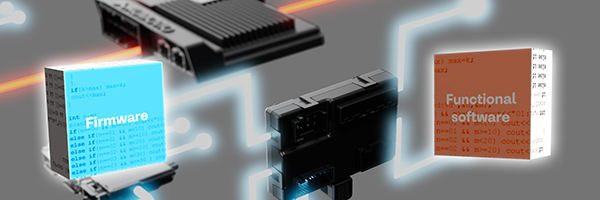
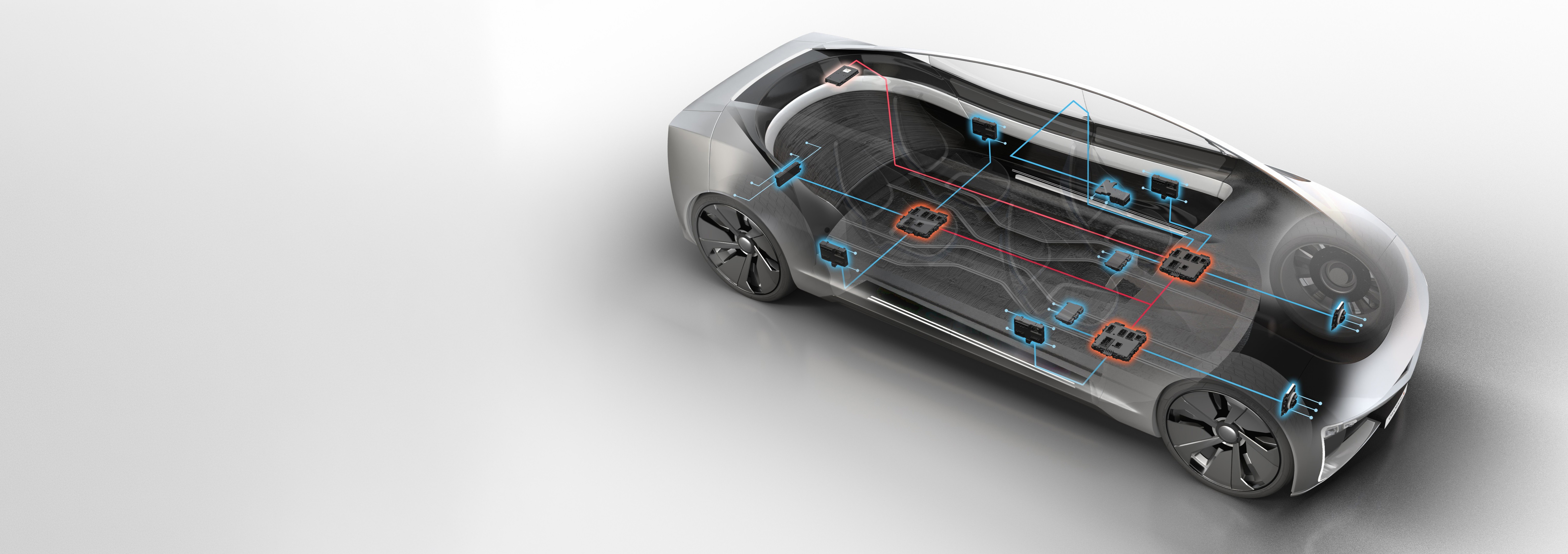
Automotive RCNet uses standardized service interfaces to connect vehicle software with sensors and actuators across Automotive Ethernet, CAN and LIN. I/O boxes are compact control units that read sensor signals and control actuators. They can handle hardware-specific and time-critical tasks locally, supporting application software reuse across different hardware implementations.

Automotive RCNet in action: the power window lifter function.
The application on the central computer requests a window movement through a standardized service interface. An I/O box near the door controls the motor and handles time- and safety-critical functions such as anti-pinch protection. Application logic runs on the central computer, while hardware-specific control remains in the I/O box.
Requests window movement.
Connects application and local control.
Controls the motor and handles anti-pinch protection.
Hardware-specific control stays local, helping the application software remain reusable across vehicle variants and enables standardized I/O box portfolio.
As vehicle architectures evolve, scalable and flexible communication concepts become essential. Automotive RCNet supports different centralization strategies, enables flexible function deployment, and is designed to simplify integration efforts for OEMs.

Service-oriented communication from central computers to sensors and actuators – across Ethernet, CAN and LIN.

Functions can be deployed on high-performance computers, zone control units or I/O boxes – based on performance, cost and system requirements.

Standardized interfaces help decouple software from hardware and enable reuse across vehicle architectures and generations.

Designed to support different centralization strategies and deployment models within a common networking concept.
Together with Elektrobit and Vector Informatik, we are advancing an open, manufacturer-independent standard for intelligent mechatronic edge devices. In China, we co-initiated the automotive RCNet standard with CAAM (China Association of Automobile Manufacturers) and leading industry partners – supporting interoperability, easier integration and greater software and hardware reuse.
Automotive RCNet complements the remote control protocol (RCP), being developed within the OPEN Alliance. RCP enables software on a central computer to access remote peripheral interfaces over Automotive Ethernet. Automotive RCNet provides service-oriented communication across Ethernet, CAN, and LIN, with hardware-specific and time-critical tasks able to remain local. The two approaches support different vehicle architecture requirements and can be used in combination.
Our ambition is to give OEMs the freedom to evolve their architectures at their own pace. Through open standards and strong partnerships, we aim to simplify integration and enable greater software reuse across vehicle platforms.
Jean-François Tarabbia
Member of the Executive Board and Head of Architecture and Network Solutions
What is the difference between legacy ECU based architectures, automotive RCNet, and remote control protocol?
Different architectures. Individual paths to SDV.

Automotive RCNet and RCP support different architecture strategies, giving OEMs the flexibility to evolve towards software-defined vehicles at their own pace.
An integrated automotive RCNet approach that supports your path to software-defined vehicles.

Integrated technology, our offering for a complete ecosystem.
Networking middleware, hardware platforms, software, and tooling within one automotive RCNet ecosystem.
Flexibility for your architecture.
Support for different centralization strategies and function deployment according to your system requirements.
End-to-end communication in action.
Our live demonstrator validates automotive RCNet connectivity from central computers to sensors and actuators using vehicle body functions as an example.
*If the contact form does not load, please check the advanced cookie settings and activate the functional cookies for the purpose of contact management.